
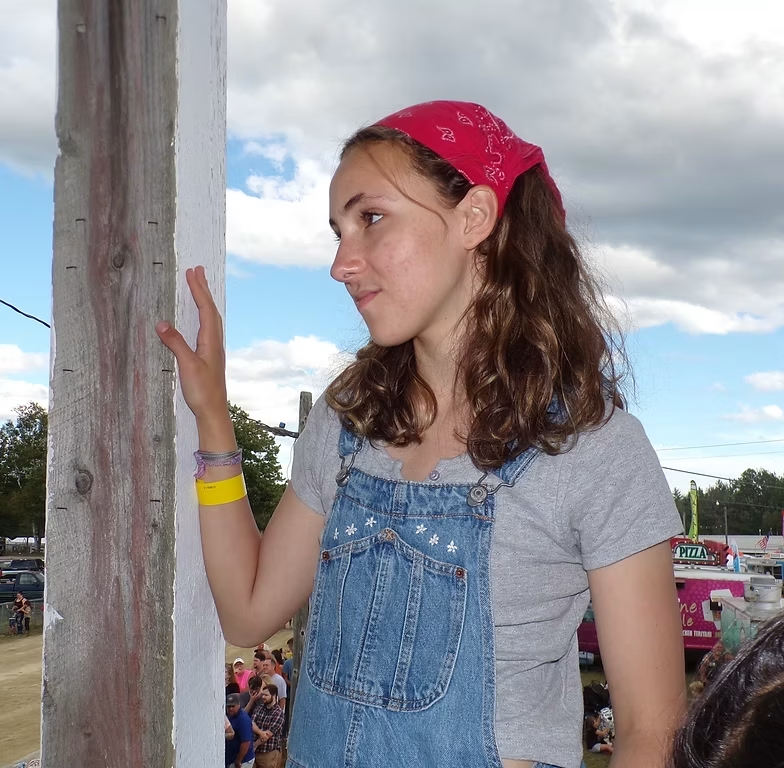
The MDI High School graduate went before the Bar Harbor Town Council with a plan for a pollinator corridor—and has since been working with town staff to figure out where it could take root.
The Bar Harbor Story is generously sponsored by Witham Family Hotels.

BAR HARBOR—Mount Desert Island High School graduate Taylor Ehrlich doesn’t just love the environment, she takes action and does something about it.
The evening before the morning she headed to Smith College for the school year, Ehrlich sat before the Bar Harbor Town Council and explained her plan for a pollinator pathway in the town.
“Maya came to me with this project,” she said of Town Council Chair Maya Caines.
Ehrlich is a rural youth organizer for Just Me Just Us and was part of Bar Harbor’s Task Force on the Climate Emergency.
“The pollinator corridor is a pathway of native plants,” she explained to the councilors, September 1.
According to the Land Resilience Partnership, “Bees, butterflies, birds & other wildlife species move pollen between plants, allowing cross-fertilization plants need to reproduce and grow. This process is necessary to grow food crops and ensure ecological health. Pollinator species are endangered due to loss of habitat from urbanization, pesticide/herbicide use, and other human activities.
“Pollinator corridors are pesticide-free paths of native plants that provide habitat & nutrients for pollinators & other small wildlife. These corridors create an opportunity for people to engage with nature in a meaningful way and to contribute to beautiful, climate appropriate landscapes.”
The overall goal is to create richer, brighter, healthier spaces for the communities, students, town, and biodiversity.
Town Manager James Smith thanked Ehrlich for her work.
“She came to us and said, ‘Hey, I want to help put this to action.’ So we put Taylor in touch with the Parks Department,” he said.
They also paired Ehrlich up with a GIS expert to look at public property that could be sites for the plants that would make up the pollination corridor.
“We’re really excited and very happy that Taylor stepped forward,” to help the town fill that void, Smith said, and move the idea from conception to implementation.

In May 2025, the Town Council agreed to explore a pollinator corridor. That order authorizes Smith to work with various groups to try to create a pollination corridor through the town.
There are areas such as parking lots, ball fields, schools, that would likely be part of the corridor.
They also hope for a potential partnership with Acadia National Park.
“Another option is to field interest with private property owners,” she said.
They’ve created a map of potential areas for the corridor and possible plant focuses as well as a timeline of work and spoke to University of Maine specialists about the recommended mix of plants.


Ehrlich is a Mount Desert Island High School graduate studying physics and international relations at Smith College.
According to her bio on Just Me for Just Us, “her work in her community is centered around Climate Activism, from Bar Harbor’s Climate Emergency Task Force to her school’s Environmental Team, as well as advocating for young women in STEM through leading Girls Who Code of Bar Harbor, a youth coding group.”
Multiple groups in the Mount Desert Island region—particularly the Town of Trenton and the Charlotte Rhodes Butterfly Garden, Acadia National Park, Frost Farms, Bar Harbor Garden Club, and the Mount Desert Garden Club—have been working (sometimes for years and decades) on expanding knowledge of gardens and their connection to pollinators and agriculture.
During the Town Council meeting, Council Vice Chair Earl Brechlin asked about the current policy and practice of pesticide applications.
They are looking into that as well, Ehrlich said, and have been talking about pest control.
He also asked about how Acadia National Park has been working on planting species that were more climate-change hardy.
“I currently have a list from the University of Maine,” she said, but needs to do more work toward climate consideration.
Councilor Joe Minutolo said, “I can see a real grassroots effort to educating anyone who has a house.”
“It is something,” Minutolo continued, “when you see the life that’s going on around flowers that are in bloom. I think people, with a little education, might jump in.”
Councilor Deborah Vickers asked about business properties as well. Councilor Steven Boucher discussed milkweed, a plant often used in corridors.
Councilor Randell Sprague said that the town’s parks employee who focuses on garden was a great resource and was happy that Ehrlich had met with him.
A final plan will come back to the council to accept so that it can be implemented.
LINKS TO LEARN MORE
Maine Native Plant Finder: To find out more about other species Maine Audubon grows, promotes, and sells for Maine gardeners and property managers, and what Maine native plants might be right for your garden or community, visit www.mainenativeplants.org.
To learn more about why native plants are important for wildlife and ecosystems, especially in developed landscapes, visit maineaudubon.org/plants.
To learn more about U.S. Fish & Wildlife Service’s Gulf of Maine Coastal Program, visit fws.gov/gomcp.
Plants promoted by Maine Audubon Which Is Not Linked to This Project.
Northern Bayberry, Myrica pensylvanica
Butterflyweed, Asclepias tuberosa
Northern Spicebush, Lindera benzoin
Seaside Goldenrod, Solidago sempervirens
New Jersey Tea, Ceanothus americanus
Blue-stemmed Goldenrod, Solidago caesia
Swamp Milkweed, Asclepias incarnata
HELP SUPPORT THE BAR HARBOR STORY
When we started The Bar Harbor Story, we didn’t know if anyone would read it. But you showed up. You shared. You sent tips. Now—over 400,000 views every month later—it’s clear: people here care about their community and each other.
We’ve kept everything free because news should never be out of reach, but every one of our stories takes time to write, and your support keeps The Bar Harbor Story going.
If you value our work, please consider a paid subscription, a founding membership, or a sponsorship.
It truly helps us cover one more meeting, tell one more story, shine one more light.
Even $5 a month makes a difference. Click here to become a one-time supporter now.
Thank you so much for being here.
Founding member information can be found here.
Have questions about sponsorships? Just send Shaun an email at sfarrar86@gmail.com, he’d love to hear from you.
Help keep the Bar Harbor Story going.
Make a monthly donation
Make a yearly donation
Choose an amount
Or enter a custom amount
Your contribution is appreciated.
Your contribution is appreciated.
Your contribution is appreciated.
Discover more from Bar Harbor Story
Subscribe to get the latest posts sent to your email.